
💰 Samuel Was Told He Could Not Afford A Car, But One Tablet Left The Salesman Speechless
“Get out! You cannot afford a car here!”
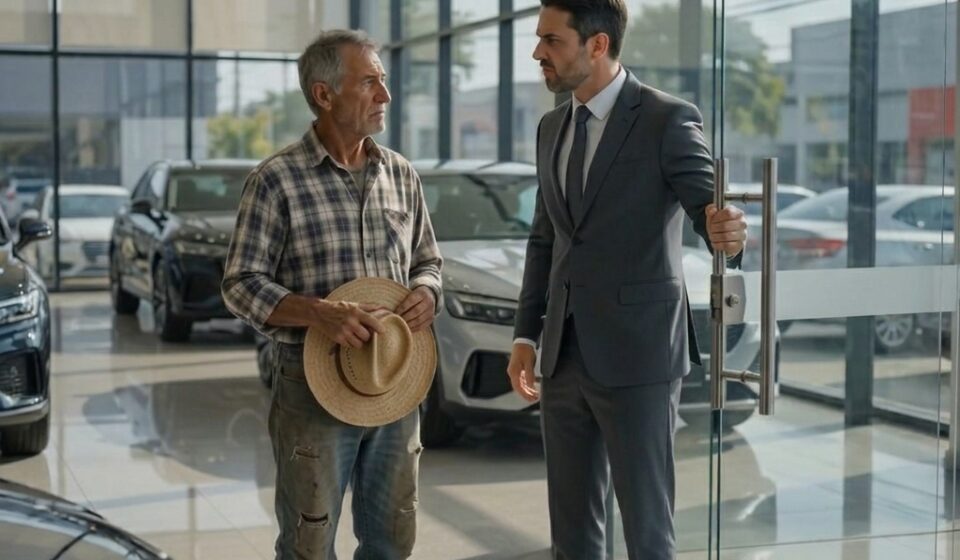
The dismissive command, delivered with sharp arrogance, echoed across the polished glass and gleaming tile floor of the luxury automotive showroom. A salesman in an expensive fitted suit pushed open the glass entrance door, motioning forcefully toward the outside street to compel an elderly visitor to leave.
The elderly visitor, a man in his late sixties named Samuel, stood calmly in the center of the showroom floor. He wore a patched plaid shirt, mud-spotted jeans tucked into heavy rubber work boots, and held a worn straw hat tightly in his calloused hands. His attire bore the clear marks of a lifetime of grueling manual farm labor. Yet, despite his humble appearance, Samuel held his head high and looked the condescending salesman directly in the eyes.
“You judge my clothes,” Samuel stated quietly, his voice steady, deep, and devoid of fear or anger.
The salesman scoffed, rolling his eyes in front of the other staff members, declaring that high-end luxury vehicles were reserved for elite clientele, not penniless farmhands who had wandered off the field.
Before the salesman could physically escort Samuel toward the exit, a female financial director in a tailored navy suit marched across the floor holding a digital tablet. She stepped directly between the salesman and Samuel, tapped her screen, and addressed the salesman with cold, unyielding authority:
“His transfer cleared! He bought every car in this showroom!”
The salesman froze instantly. His grip on the door handle slipped, and the set of car keys he was holding tumbled out of his hands, clattering loudly against the tiled floor. His face drained of color, his jaw dropped in complete shock, and his eyes widened in terror as he looked back and forth between the digital receipt on the tablet and the humble farmer standing before him.
The salesman’s arrogant prejudice was completely shattered, Samuel’s quiet dignity was vindicated in front of the entire dealership staff, and the haughty employee stood utterly ruined by his own foolish assumptions.
However, the reason behind Samuel’s massive financial transfer, the story of his rugged farm hands, and the secret connecting him to the dealership concealed a far deeper story of family devotion, decades of quiet sacrifice, and triumphant redemption.
The Silent Sacrifice of a Farmer
Thirty-five years earlier, Samuel was a young father working a small, debt-ridden plot of land in the countryside. When his wife passed away unexpectedly, Samuel was left alone to raise their infant son, David. Determined to give his son every advantage in life, Samuel swore that no matter how hard he had to work, David would never know the pain of poverty or be denied the opportunities of higher education.
Samuel worked from pre-dawn until long after dark every single day. He tilled the soil, tended livestock, and took on extra laboring shifts at neighboring industrial farms during the harsh winter months. His hands grew thick and calloused, his boots worn and stained, and his clothes mended with patches upon patches.
Every dollar earned was divided with mathematical precision. Samuel kept only what was necessary for basic farm supplies and bread, while setting aside every remaining cent into a dedicated fund for David’s future.
When David was accepted into a prestigious business school in the capital, Samuel sold his most fertile tract of farmland to pay the tuition in full. Throughout David’s university years, Samuel continued to live in a modest wood-frame house, eating simple meals and working the remaining land alone, refusing to let his son worry about financial burdens.
A Hidden Fortune and a Lesson in Character
Unknown to David and the rest of the community, the remaining land Samuel owned contained rich mineral deposits. Five years prior to the event at the dealership, a major clean energy company discovered that Samuel’s property sat atop one of the largest reserves of specialized quartz necessary for solar panel manufacturing.
When the corporation purchased the mining rights, Samuel became an overnight multi-millionaire.
Yet, Samuel changed nothing about his personal habits. He continued to live in his humble farmhouse, wear his patched plaid shirts, and work the land with his own hands. He donated millions anonymously to local schools, hospitals, and rural agricultural cooperatives, keeping only what he needed to secure his family’s legacy.
Meanwhile, his son David had pursued a career in corporate finance and eventually invested in a group of luxury automotive dealerships across the region. David was a success, but Samuel began to worry that the fast-paced world of corporate wealth might cause his son and his business managers to forget the core values of respect, humility, and human dignity.
Samuel decided to test the culture of David’s flagship dealership personally before finalizing a massive corporate grant he intended to gift to his son’s business network.
The Ultimate Showroom Test
On the day of the confrontation, Samuel walked into the luxury showroom uninhibited, purposefully wearing his working clothes, mud-stained boots, and straw hat. He wanted to see how the dealership’s staff treated an ordinary working man who showed up without the trappings of wealth.
The result was immediate and appalling. The lead salesman made no effort to greet him, mocked his appearance, and attempted to throw him out into the street.
What the salesman did not realize was that just twenty minutes prior to walking through the doors, Samuel had met with the dealership’s financial director in her private office. Samuel had executed a wire transfer of millions of dollars, purchasing the dealership’s entire inventory of luxury sedans, SUVs, and sportscars outright—vehicles he intended to donate to rural medical transport fleets and regional charity organizers.
When the financial director brought out the cleared transfer document, the salesman’s cruelty came back to haunt him in front of the entire staff.
The Truth Revealed
As the salesman stood paralyzed on the floor, the private elevator at the back of the showroom opened. David, the owner of the dealership group and Samuel’s son, stepped out onto the floor for an unannounced inspection.
Seeing his father standing in his farm clothes holding his straw hat, David bypassed his executive team, walked straight across the showroom, and embraced Samuel warmly in front of everyone.
“Dad! What are you doing here?” David asked with a proud, warm smile.
The arrogant salesman, trembling with fear, tried to step forward to explain, but David held up his hand. The financial director handed David the transaction log and briefed him on how the salesman had just treated the man who had just purchased the entire showroom inventory—and who happened to be the owner’s father.
David’s expression turned stern. He looked at the salesman with deep disappointment.
“My father wore these same clothes and worked eighteen hours a day in the mud to pay for my education and build everything I own,” David said, his voice echoing clearly through the silent showroom. “If you cannot respect a man in mud-stained boots, you have no place representing my company.”
David terminated the salesman’s contract on the spot for gross misconduct and violation of basic ethics.
A Legacy of Humility
Following the incident, Samuel and David restructured the operational policies of the entire dealership group. They implemented strict guidelines requiring every employee to undergo training in human dignity and respectful customer service, ensuring that every person who walked through the doors—regardless of their attire, background, or perceived wealth—was treated with absolute courtesy and care.
The cars Samuel purchased were delivered to regional health services and rural community charities, providing essential transportation for doctors, social workers, and patients across the state.
Samuel retired his heavy work boots, dividing his time between the farm and working alongside David to manage the Samuel Miller Foundation for Working Families, an organization dedicated to providing scholarships and financial assistance to the children of agricultural workers and manual laborers.
The key that the salesman had dropped on the floor, along with Samuel’s worn straw hat, was placed inside a glass display case in the center of the showroom lobby.
Beside the display, a polished brass plaque was installed on the marble wall, bearing a message that every employee and customer would see upon entering:
“Never judge a person’s worth by the clothes they wear, the boots on their feet, or the mud on their hands. True nobility is found in the integrity of the soul, the honesty of hard labor, and the quiet sacrifices made for love. Respect every human being who enters these doors, for the humblest coat may cover the greatest heart.”